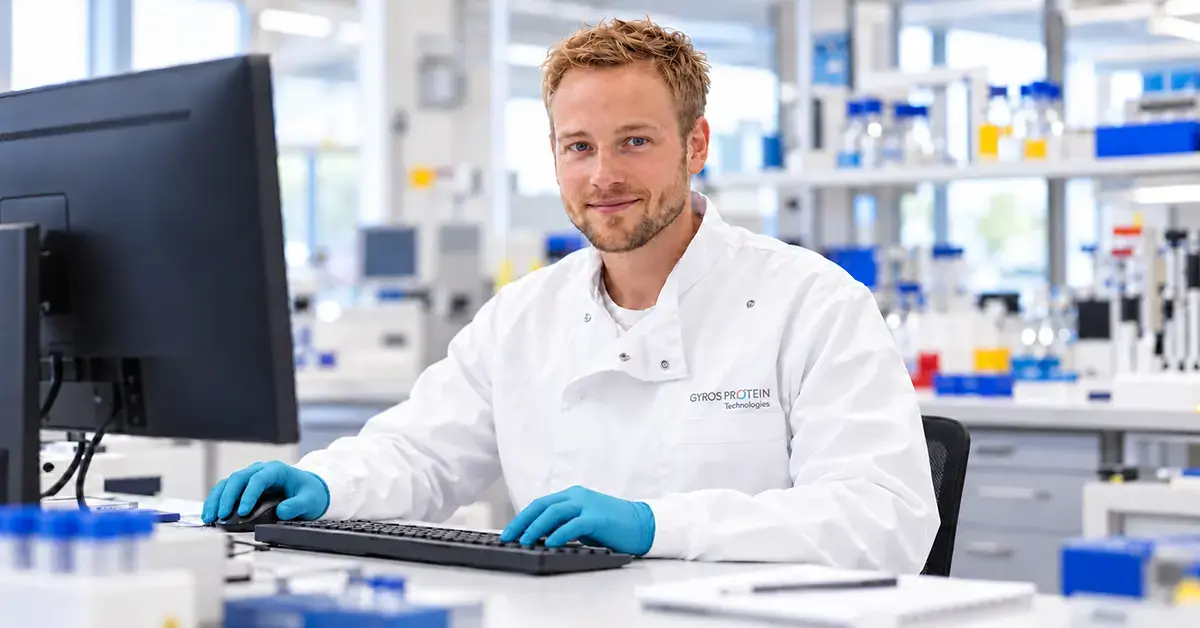
Titer and impurity data for viral vectors — in about an hour

Gyrolab® automates your immunoassays at nanoliter scale, so you get AAV capsid titer, host cell protein (HCP), and other process-related impurity data faster, from less sample, and with fewer manual steps. From discovery through GMP release testing.

  • Automated nanoliter-scale immunoassays — results in about an hour
  • Reduces sample and reagent consumption by up to a hundredfold
  • Run duplicates from as little as 8 µL of sample 
  • Automates up to 960 immunoassay datapoints per day
Titer and impurity data for viral vectors — in about an hour
 

 Gyrolab for cell and gene therapy bioprocess analytics  

~ 1 hour

Assay time, against four to six hours for a traditional plate-based ELISA workflow 

8 µL 

Sample needed to run duplicates with the AAVX Titer kit 

3 logs

Analytical range in a transferred AAV2 assay, up from about two logs on the plate-based ELISA 

 <10% CV 

Precision reported for transferred titer and p24 methods 

Why does automating immunoassays change your timeline?

Answer first: because the slow part of an immunoassay is rarely the chemistry — it is the pipetting, the dilutions, the incubations, and the reruns. Gyrolab runs the assay inside a disc with nanoliter-scale microstructures, instead of a microtiter plate. The instrument automates liquid handling and detection, and short flow-through times replace long plate incubations. You start the run and come back to data.

Namnlös design (31)

How does automation reduce variability in immunoassays?

Fewer manual steps mean less variability. When Gyrolab® automates liquid handling, your assay precision depends far less on each analyst's pipetting technique.

At VIVEbiotech, a p24 assay used to quantify lentiviral vectors moved from a manual ELISA to Gyrolab. Total assay time fell from more than 6 hours, about 4 of them hands-on, to under 2.5 hours. Precision improved from up to 20% CV to below 10% CV, with recovery of around 99%. 

Methods that are easy to transfer-1

Why are Gyrolab assays easier to transfer between labs?

An automated assay is easier to transfer because there is less manual technique to hand over. Gyrolab® performs each step the same way in every lab, so your method behaves more consistently at the receiving site.

Panelists in a Cell and Gene Therapy Insights discussion made the same point. Absolute response values can differ slightly between instruments, but the standard curves, and the concentrations you calculate from them, stay consistent.

Throughput you can plan around.

How much throughput can you plan for with Gyrolab?

Gyrolab gives you throughput you can plan around. As a rule of thumb, the single-disc Gyrolab xPlore system handles about 6 discs a day, roughly 570 datapoints. The five-disc Gyrolab xPand system handles about 10 discs a day, up to 960 datapoints, depending on how you schedule your runs.

Runs are unattended, so you can load the instrument in the evening and collect your data in the morning.

All microstructures on a disc are processed in parallel. That avoids the edge effects and time-dependent drift that can affect plate-based assays

Faster method development.

Why use an open platform with ready-to-use kits for bioprocess testing? 

An open platform with ready-to-use kits lets you run both trending assays and targeted assays on one system. Trending assays show how your process performs over time, and targeted assays confirm that your critical quality attributes (CQAs) are met.

Ready-to-use Gyrolab® kits for HCP, AAV and Lentiviral capsid titer, endonuclease and other process-related impurities let you start trending without developing an assay first. When a CQA calls for a product-specific target, you can run in-house assays with your own antibodies.

Both run with the same automation and software, so your data stays consistent. Methods can also move from non-GMP trending to GMP testing without changing platforms.

Ask yourself, how many of your reruns are caused by the method — and how many by a dynamic range that forces you to dilute and guess?

Why do small sample volumes matter so much in gene therapy analytics?

Answer first: viral vector material is expensive to produce, and every microliter you spend on one assay is a microliter you cannot spend on another. Gyrolab measures inside a pre-packed 15 nL affinity column, so a titer measurement takes as little as 8 µL for duplicates — and the sample you save can go toward another attribute, or toward the patient.

Three practical consequences:

One assay multiple samples

You get the sample back for other tests. Wherever an ELISA sits in your analytical workflow, an automated nanoliter-scale immunoassay can often take its place and leave you material to work with. Small volumes also let you run several quantifications from one sample — an approach we call Gyroplexing. On the five-disc system you can load a titer assay, an HCP assay, a residual endonuclease assay, and a ligand leakage assay and walk away, and return to data from all four.

matrix effects

Complex matrices interfere less. The flow-through affinity format keeps contact between sample and reagent short, and the column captures the analyte away from the matrix. That is why crude lysate is workable: In a recent webinar a Gyrolab user reported on minimal matrix effect in clarified crude lysate, with capsid titers that tracked viral genome titers by digital PCR — and comparable technical error between the two methods — even as matrix composition changed between lysis methods.

Gyrolab broadens dynamic range. In a transferred AAV2 assay, analytical range grew from about two logs to about three resulting in less dilutions and reruns.

Less dilution work, fewer reruns. Laser-induced fluorescence gives a broad dynamic range, so you hit the standard curve on the first attempt more often. In a transferred AAV2 assay the analytical range went from about two logs to about three. At high titers on a high-concentration disc (roughly 10¹⁰–10¹²), the customer measured some samples with no dilution at all — 4 µL for triplicates, transferred straight to the sample plate.

Volume comparison, from published case studies


Assay

Conventional method

Gyrolab

Blog

AAV2 capsid titer

100 µL per test (plate-based ELISA)

10 µL per test

From plate-based ELISA to automated: how labs get AAV titer results in about an hour

AAV capsid titer, AAVX kit

—

8 µL for duplicates

Measuring AAV capsid titer in crude lysate — without the matrix headache

AAV capsid titer, high-concentration disc

—

4 µL for triplicates

Measuring AAV capsid titer in crude lysate — without the matrix headache

AAV capsid titer, BLI-based approach

200–250 µL per measurement

8 µL for duplicates

Measuring AAV capsid titer in crude lysate — without the matrix headache

Lentiviral p24

~50 µL per sample

Lower volume, at CV below 10%

Viral vector titer and impurity data — in about an hour

Viral titer testing: can you measure AAV capsid and lentiviral titers reliably—including in crude lysate?

Answer first: yes. Gyrolab quantifies AAV capsid titer across serotypes using ready-to-use kits, and because the affinity column separates the capsid from the matrix, it supports quantification in non-diluted, complex material such as clarified crude lysate. Depending on the disc and titer range, the assay has covered about 10⁸ to 10¹².

What you can measure

    • AAV capsid titer across serotypes with the Gyrolab AAVX Titer Kit, with a dedicated kit for AAV9. Together they cover the serotype range.
    • Lentiviral p24, a key lentivirus marker, with a ready-to-use kit.
    • Your own assay, if you prefer. The platform is open: use reagents from Gyros Protein Technologies, your own, those from your existing ELISA kits, or a combination.

Four things titer teams consistently report


highter throughput

Higher throughput, multiple serotypes. A CDMO with an extensive gene therapy analytical platform, evaluated Gyrolab to raise throughput in upstream and downstream process development. Using the five-disc system, they measured three AAV serotypes — two with the AAVX kit and AAV9 with the dedicated kit. Against their manual ELISA, they saw a lower limit of quantification, a broader dynamic range, and acceptable CVs. They also showed that calibration controls could replace multiple standard curves, raising throughput further, with results consistent across three runs and against commercial reference material.

low variability

Low variability, less repeats. At a lentiviral vector CDMO, one platform handled p24, HCP and Benzonase® testing across sample types and concentrations. Their p24 method passed a full seven-parameter validation — precision, accuracy, linearity, specificity, robustness, LOD and LOQ — showing high precision with minimal matrix effects and strong robustness to sample preparation and disc position. The outcome they reported: release results about three times faster, lower variability, fewer repeated assays, and better data integrity, including operator and date traceability that supports GMP compliance.

04_reliable_ranking

Reliable ranking in media development. One Gyrolab user needed reproducible capsid titer in crude lysate to rank cell culture media formulations. Serial dilutions at 10×, 20× and 40× gave minimal variance in calculated titer, so the team settled on a single 20× dilution for most unknowns. Results held for AAV2 — which tends to aggregate and is more prone to matrix effects — and AAV5, and from small formats up to a bioreactor run. All of that data was collected in two and a half days by a first-time user.

How the results look

Each microstructure produces one datapoint, shown as a peak in the result file — and its own column profile. The peak shape tells you something about data quality, so you can use it to troubleshoot or fine-tune conditions. It is a level of visibility an OD readout in a well does not give you.

Impurity testing: kits, or your own assay?

Answer first: both work, and it rarely has to be either/or. Start with a kit if one exists — supply and control are simpler, and validation groups tend to be more confident in a widely used kit. Develop a custom assay when you need lower quantitation, cell-line-specific coverage, or independence from a single supplier.

Why impurity data carries weight

Residual host cell proteins, nuclease, resin ligand traces and other process-related contaminants can drive immunogenicity, contribute to toxicity, and affect product stability. Keeping them in check is a core part of showing that a drug product is safe — and you often have to measure all of it from very little material.

In-house and custom HCP assays

When does building your own HCP assay pay off? When cost per sample, supply risk, or sensitivity are limiting you — and when you want the deep method understanding that helps during out-of-specification investigations.

The analytical development team at a gene therapy biopharma retired a commercial HCP kit for exactly those reasons: roughly $800 per plate, and the exposure of depending on a single vendor for a regulated assay. They produced their own antigen from a null cell line, confirmed it was representative on 2D gels, and had a polyclonal antibody raised against it — reaching 75–82% coverage of the custom antigen.

They then ran the same custom reagents on two platforms, and kept both:


Custom ELISA

Custom Gyrolab assay

LLOQ

5 ng/mL

1 ng/mL—five-fold lower

Standard curve

200–1.56 ng/mL

1000–0.46 ng/mL

Samples per run

Baseline

Roughly five times more

Hands-on time

Higher; every addition means an incubation and a wash

About an hour, essentially just sample and standard prep

Development time

~1–2 months

~1 month

Where it sits

Transferred to QC for release testing

Platform method for high-volume in-process testing in analytical development

Run on the same samples, both assays gave comparable results and showed the same HCP clearance from harvest to drug substance—the sign that the reagents, not the format, were doing the work. And because antibody production was the long pole at close to nine months, the honest planning lesson is that the reagents are the project, not the assay.

If a kit is close but not quite right, there is a middle path. Our custom assay service has built kits around proprietary or commercial reagents since 2021, quality-controlled for consistent performance and supplied as complete kits or individual reagents. One customer with high lot-to-lot variability in a commercial HCP ELISA sourced their own antibodies; our team labeled them and developed an optimized Gyrolab protocol. Custom assays also cover cell-line-specific HCP, AAV capsid, and ligand leakage assays.

Does it hold up for regulated work?

21 CFR Part 11Yes, Gyrolab data has been submitted to the FDA, the software supports 21 CFR Part 11 workflows with LIMS interface options, and the platform is in use across bioanalytical, GLP, GMP, GCP, QC and CRO/CMO settings — from discovery through commercialization. Gyrolab has been validated and in use for late-phase work and product release, with plans to include it in a BLA commercial application by multiple Gyrolab users.
What matters for any immunoassay is the same underlying discipline: the method is fully validated, the system is fully qualified, and computer systems validation is in place.

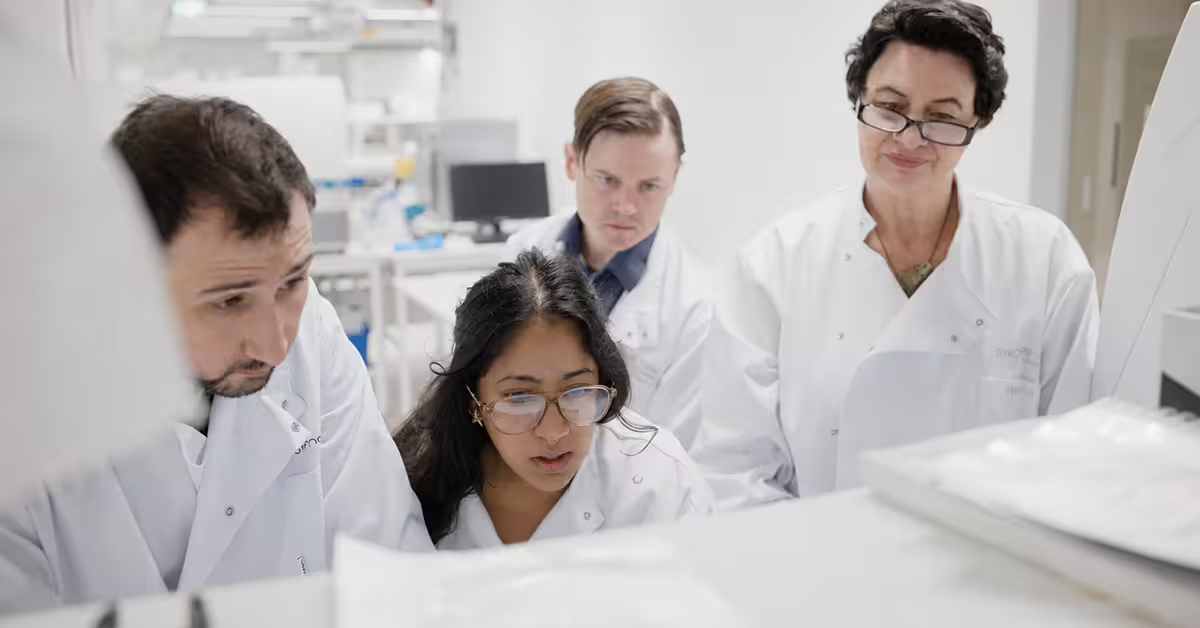
A QC panel of scientists kept returning to the same short list when asked what makes an assay work in QC: results on time, low sample volume, good reproducibility, cost-effectiveness, and something you can validate, automate and miniaturize. Robustness across batches, days and operators is what separates a method that survives in QC from one that does not. As one panelist put it, almost anything can be done under GMP as long as it is controlled — the real question is how hard that control is to achieve, and data integrity is often the biggest hurdle. So the goal is not to take on the hardest challenge; it is to choose systems that are simple to run and simple to keep compliant.

Where does Gyrolab fit in your program?


Stage

What you need

What Gyrolab gives you

Early development

High analytical pressure, little material

8 µL duplicates; unattended runs; results in about an hour

Upstream and media development

Reliable ranking from crude lysate

Minimal matrix effects; linearity across dilution factors; agreement with digital PCR

Process development

Throughput without a backlog

Up to 960 datapoints per day; gyroplexing titer, HCP and endonuclease from one sample

Method transfer to QC

Robustness and traceability

Less manual technique to hand over; near-identical standard curves between instruments

GMP release testing

Validated, controlled, auditable

Seven-parameter validation demonstrated; 21 CFR Part 11 support; FDA submissions

Being straight about the limits. You still handle your own sample dilutions. If your application needs femtogram-level sensitivity, the platform may not be the right fit. 

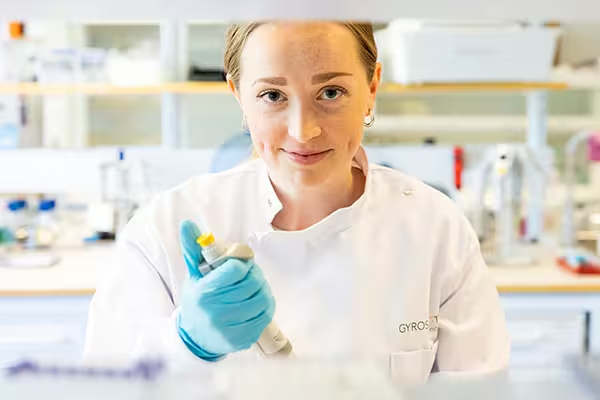
Scientist woman

Looking to reduce assay time and free up lab resources in your gene therapy program?

Tell us which attribute is slowing you down — titer, HCP, residual endonuclease, residual resin ligand — and we will talk through what a Gyrolab method would look like for your samples and matrices.


Resource hub

Blog: Viral vector titer and impurity data — in about an hour

Viral vector titer and impurity data — in about an hour
Three case studies — Pharmaron, VIVEbiotech and a custom HCP assay — showing how automated nanoliter-scale immunoassays support AAV titer and impurity analysis from discovery to QC. 

From plate-based ELISA to automated  how labs get AAV titer results in about an hour

From plate-based ELISA to automated: how labs get AAV titer results in about an hour
Two customer case studies on replacing a manual AAV titer ELISA — comparability, dynamic range, dilutional linearity — plus the questions analytical scientists and lab managers asked. 

Measuring AAV capsid titer in crude lysate — without the matrix headache

Measuring AAV capsid titer in crude lysate — without the matrix headache 
How Fujifilm Irvine Scientific measures AAV capsid titer in clarified crude lysate for cell culture media development, with linearity across dilution factors and agreement with digital PCR.

Blog: Bringing HCP testing in-house: how one gene therapy team cut supply risk and hands-on time

Bringing HCP testing in-house: how one gene therapy team cut supply risk and hands-on time
Why one analytical development team retired a commercial HCP kit, built custom reagents, and now runs an ELISA in QC and a Gyrolab assay in development — with five-fold lower quantitation. 

Faster data for gene therapy — what a QC panel taught us (2)

Faster data for gene therapy — what a QC panel taught us
Four scientists on running immunoassays in gene therapy QC: what makes a method survive validation, kit versus custom, method transfer, and what they want from the next five years. 

FAQ

The disc takes samples and reagents from a standard microtiter plate, so any liquid handler that works with microtiter plates fits alongside it — customers run full workflows with systems such as Hamilton and Echo.