Oligonucleotides

Oligonucleotide analysis with the Gyrolab immunoassay platform  

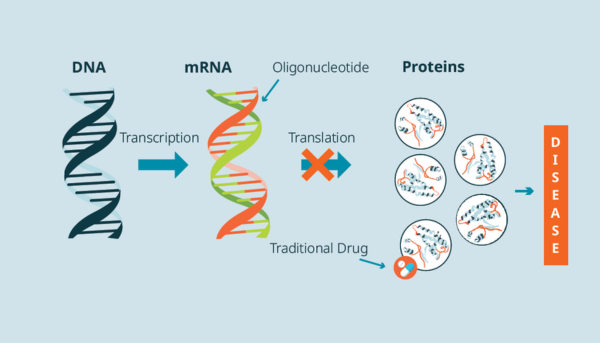
Oligonucleotide-based therapies are a growing part of modern drug development, including antisense oligonucleotides (ASO), siRNA, and mRNA. These molecules require sensitive and reliable analytical methods to quantify distribution, exposure, and stability across biological matrices.

Gyrolab supports oligonucleotide workflows with automated hybridization assays designed for small sample volumes, high sensitivity, and consistent performance. This makes it well suited for pharmacokinetic studies and tissue distribution analysis across development stages.

Common oligonucleotide modalities include:

  • Antisense oligonucleotides (ASO) - Single-stranded molecules designed to bind RNA and modulate gene expression.

  • Small Interfering RNAs (siRNA) - Double-stranded RNA molecules that degrade target mRNA and reduce protein expression.

  • Messenger RNA (mRNA) - Synthetic RNA used to instruct cells to produce therapeutic proteins.

  • Antibody-oligonucleotide conjugates (AOC) - Combine targeted delivery from antibodies with the functional effect of oligonucleotides. 

Oligonucleotide analysis with the Gyrolab immunoassay platform

Hybridization assays for oligo detection

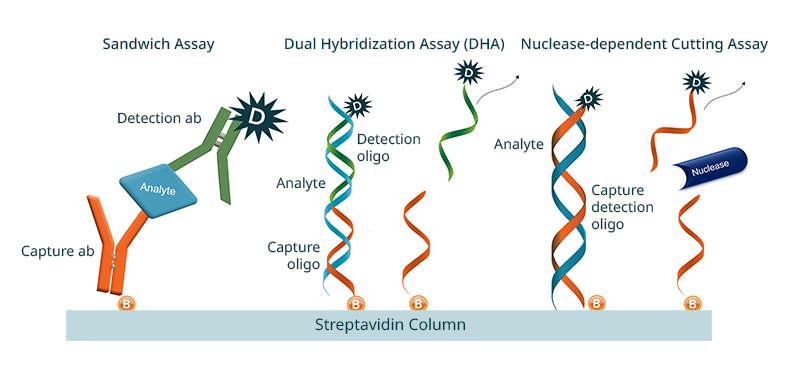
Hybridization assays differ from traditional immunoassays by using complementary oligonucleotide sequences instead of antibodies for capture and detection. This enables selective and sensitive detection of oligonucleotide drugs in complex biological samples. 

Dual hybridization assay (DHA) 
Uses one capture and one detection oligonucleotide. Signal is generated only when the target analyte binds both probes, improving specificity. 

Nuclease-dependent cutting assay (NCA) 
Uses a full-length probe that is cleaved unless bound to the target. This improves selectivity for the intact parent oligonucleotide and reduces background signal. 

Automated hybridization assays to measure ASO drug levels in biological  samples image 2

How Gyrolab supports oligonucleotide analysis

Gyrolab combines microfluidic technology with automated assay execution to support demanding oligonucleotide workflows.

Hybridization assays can be run with controlled conditions and minimal manual handling, improving reproducibility and reducing the need for troubleshooting. The platform supports pharmacokinetic analysis, biodistribution studies, and biomarker measurements across discovery and development.

Key benefits for oligonucleotide applications

Nanoliter-scale precision-3

 High sensitivity in small volumes  
 Detect low-abundance oligonucleotides using nanoliter-scale reactions, even in limited or difficult sample matrices.  

High reproducibility

Consistent, reproducible data
Automated workflows reduce variability between runs, operators, and sites - supporting reliable comparisons across studies.  


Broad dynamic range-2

Broad dynamic range
Quantify both low and high concentrations without repeated dilution steps, keeping more samples within range.  

Versatility-1

Strong matrix tolerance
Flow-through assay format helps reduce interference from serum, plasma, and tissue homogenates.

10

Efficient workflows
Process multiple samples in parallel with minimal hands-on time, helping teams move faster from data to decisions.


Case study 

Automated hybridization assays to measure ASO drugs

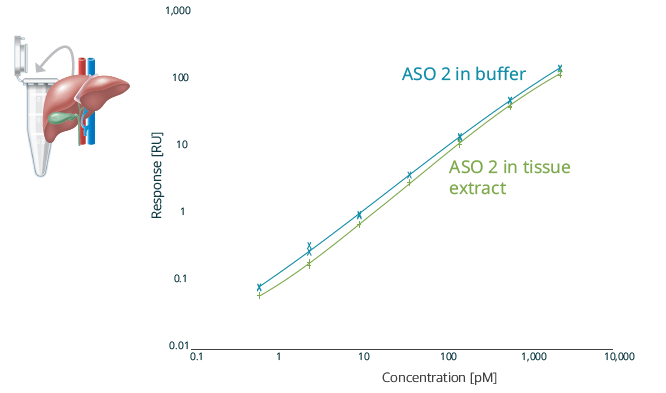
Hybridization assays on the Gyrolab platform enabled reliable detection of antisense oligonucleotide drug mimics in biological samples.

Single-digit picomolar concentrations were quantified reproducibly in serum and tissue homogenates, demonstrating the sensitivity and robustness of the automated workflow.

DHAs for oligo quantification in tissue homogenates image 4

Case study   

Hybridization assay development for oligonucleotide workflows

Automated assay setup and execution support consistent performance across oligonucleotide applications. Standardized workflows help reduce variability and simplify transfer between teams and sites.

Gyrolab vs ELISA for biosimilar analysis 

Time to results

Time to results

Results in just over an hour, compared to several hours or overnight with ELISA.

Hands-on time

Hands-on time

Automated processing reduces manual pipetting and intervention.

Dynamic range

Dynamic range

Fewer dilutions are needed to bring samples into range.

Matrix tolerance

Matrix tolerance

The flow-through format reduces background in complex matrices such as serum.

Sample volume

Sample volume

Nanoliter-scale assays require significantly smaller sample volumes than plate-based methods.

Scalability

Scalability

Seamlessly transition from discovery to development and manufacturing using the robust high-throughput systems from Gyrolab.

ask an expert

Take the next step

Looking to improve sensitivity and reduce manual work in your oligonucleotide workflows?

Talk to a specialist to explore how automated immunoassays can support your timelines and data needs.