Antibody-drug conjugate (ADC)

ADC bioanalysis - clarity in complex workflows 

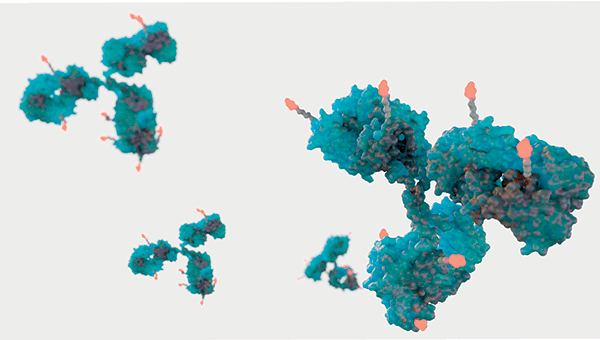
Antibody–drug conjugates (ADCs) combine a monoclonal antibody, a cytotoxic payload, and a linker designed for targeted delivery. This structure enables precise treatment, but also introduces analytical complexity across development and bioanalysis.

To understand ADC performance, you need to measure multiple parameters, including drug-to-antibody ratio (DAR), pharmacokinetics (PK), and immunogenicity. These analyses are often performed under challenging conditions, with limited sample volumes, complex biological matrices, and strict regulatory expectations.

Gyrolab supports ADC bioanalysis with automated, nanoliter-scale immunoassays that help you generate consistent, reliable data across workflows. Reduced manual handling and strong matrix tolerance make it easier to work with complex samples, while a wide dynamic range helps keep more samples within quantification limits. 

ADC (2)
As ADC pipelines continue to grow, scalable and reproducible workflows become essential. Gyrolab helps you manage this complexity - supporting both development timelines and regulatory requirements. 

How Gyrolab supports ADC bioanalysis

Gyrolab delivers automated, nanoliter-scale immunoassays designed to handle the complexity of ADC workflows. By combining microfluidic control with standardized automation, the platform helps you generate consistent, high-quality data across studies.

Reduced manual handling improves reproducibility, while the small-volume format supports work with limited or valuable samples. A broad dynamic range and strong matrix tolerance make it easier to quantify ADC-related analytes across different biological conditions.

Gyrolab supports bioanalytical workflows from early development through validation and clinical studies. The platform is used by biotech companies, CROs, and pharmaceutical organizations looking to scale their assays while maintaining confidence in their data

Free playload

DAR and PK quantification

joris

Total or conjugated antibody measurement

ADA result

ADA and biomarker analysis

lab2

Method development and validation for regulated environments

Key Benefits for ADC Development 

The Gyrolab platform enables efficient and scalable immunoassay workflows designed specifically for the challenges of antibody–drug conjugate bioanalysis.

Fast method development and screening
Complete method development and screening workflows in as little as one week, accelerating assay readiness for ADC programs.

Minimal sample and reagent consumption
Only 5–10 µL total sample volume is required for triplicate analysis- ideal for precious preclinical and clinical samples.

Superior matrix tolerance
Controlled microfluidics improve assay performance in complex biological matrices.

High-quality data with wide dynamic range
Generate robust results with low MRD and high assay pass rates (>95%).

Multiplexed analytical capability
Simultaneously analyze total antibody, total ADC, and anti-drug antibodies (ADA) within the same workflow.

Lower reagent usage
Consumes significantly less capture and detection reagent than traditional ELISA (0.05 µg vs 1 µg per plate).


Case study

Accelerating ADC assay development at Pfizer 

Pfizer researchers streamlined ADC immunoassay development using the Gyrolab platform combined with Design of Experiments (DoE) methodology.

The team rapidly developed and validated three ADC immunoassays while achieving:

  • GxP-quality assay development in just 6 days

  • Throughput of up to 240 samples per day

  • Reproducibility with %CVs under 5%

  • Assay precision and total error comparable to ELISA

  • Significantly reduced reagent consumption and hands-on time

These results demonstrate how automated immunoassays can accelerate assay development while maintaining high analytical performance.

QC summary for TA assay​-1

“We were able to go from method development to GxP-ready assays in under a week — without compromising on accuracy or throughput.”

Senior Scientist, Pfizer Preclinical Bioanalysis

Resources

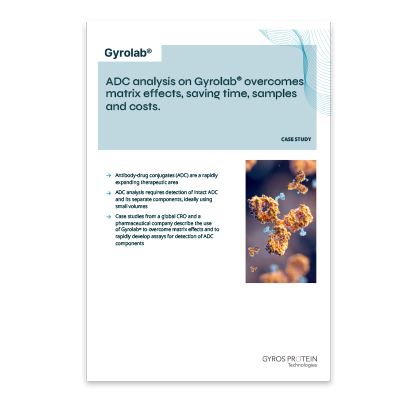
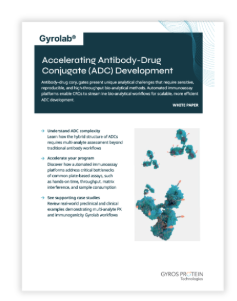
White Paper – The Rise of Antibody–Drug Conjugates

Explore the scientific and analytical drivers behind ADC innovation, including:

  • Analytical demands of next-generation ADCs
  • ADC assay development and DAR accuracy
  • Matrix interference and PK analysis considerations
  • Opportunities for automation and process efficiency
  • Industry trends across biotech, pharma, and CROs

Learn how Gyrolab supports diverse ADC formats, including cleavable and non-cleavable linkers and payloads such as MMAE, DM1, and Topo I inhibitors 

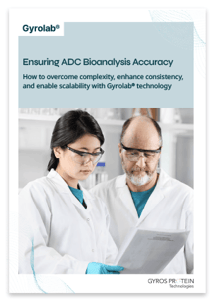
eBook – Ensuring ADC Bioanalysis Accuracy

Discover how leading CROs and biopharma organizations use Gyrolab immunoassays to analyze complex ADC samples in both preclinical and clinical studies.

Topics include:

  • Quantification of total and active ADCs in PK studies

  • Solutions for matrix interference in ADC PK analysis

  • High-throughput and low-volume PK studies in mice

  • Analysis of complex bispecific ADC formats

Validation and data confidence

Gyrolab is used in bioanalytical preclinical and clinical environments where data integrity, traceability, and reproducibility matter. Automated workflows reduce operator-dependent variation, while software support provides audit trails, controlled user access, and structured data handling to support compliance with GLP/GMP expectations.

Assays can be transferred between systems and sites with reproducible results, supporting long-term studies and regulatory submissions without added complexity.


ask an expert

Ready to simplify complex ADC bioanalysis?

Talk to a specialist to learn how Gyrolab can support your ADC development workflows.