NAMs & the 3Rs 

Enable low-volume bioanalysis for next-generation drug development

New Approach Methodologies (NAMs) are changing how biopharmaceutical teams evaluate safety, efficacy, and translational biology. But many NAM workflows share a practical limitation: they generate very small sample volumes.

Gyrolab® automated immunoassays help scientists generate high-quality PK, ADA, and biomarker data from minimal sample volumes, supporting more efficient preclinical and translational workflows aligned with the 3Rs: Reduce, Refine, and Replace.

NAMs and the 3Rs-1

Supporting NAM-enabled bioanalysis

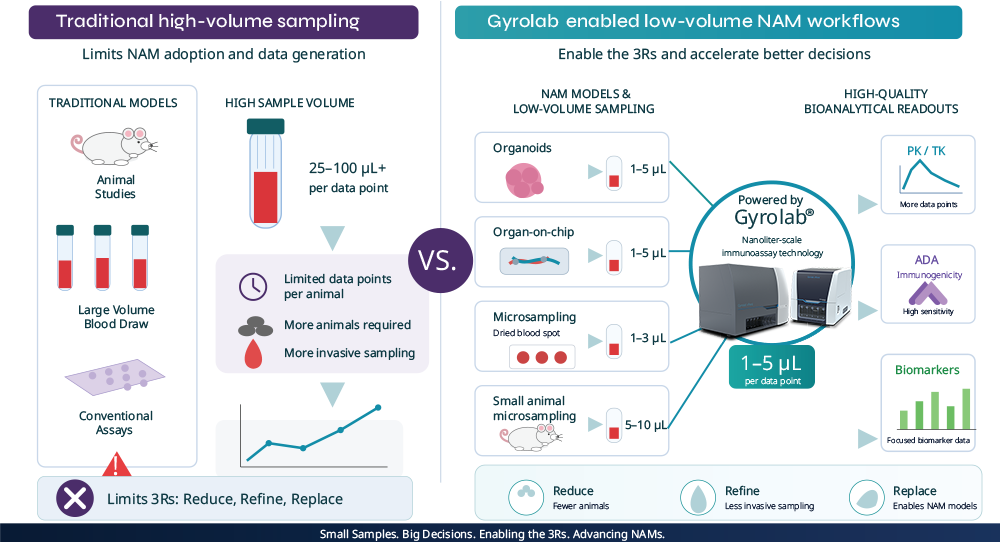
Alternative models such as organoids, organ-on-chip systems, microphysiological systems, and microsampling studies can provide powerful biological insight. To make these models useful in drug development, teams need analytical methods that can measure critical readouts from very limited material.

Gyrolab nanoliter-scale immunoassay technology combines automated workflows, low sample consumption, broad dynamic range, and reproducible data generation - helping teams move from limited sample to confident decision-making.

How Gyrolab supports the 3Rs

Reduce animal use

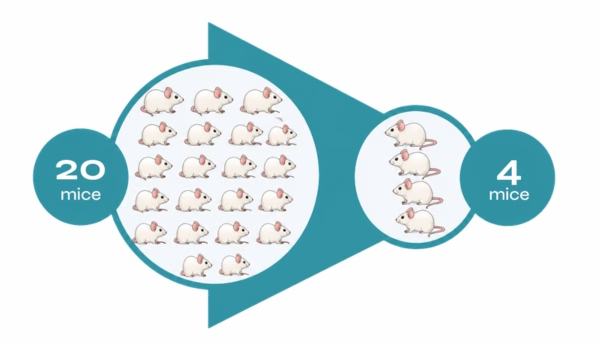
Low sample volume requirements help researchers generate more data from each available sample. In preclinical studies, this can support reduced animal numbers, fewer repeat experiments, and more efficient study designs.

Gyrolab helps by:

  • Using very small sample volumes

  • Enabling more measurements from limited samples

  • Reducing repeat testing through broad dynamic range and reproducible performance

Refine sampling strategies

When studies require animal samples, smaller volume requirements can support less invasive sampling approaches and improved study design flexibility.

Gyrolab helps by:

  • Supporting microsampling-compatible workflows

  • Reducing sample demand compared to traditional plate-based assays

  • Automating immunoassays to minimize hands-on variability

Enable replacement models

Many replacement-oriented NAMs produce small-volume outputs that can be difficult to analyze using conventional methods. Gyrolab can help make these models more analytically viable by enabling sensitive immunoassay readouts from scarce samples.

Gyrolab helps by supporting readouts from:

  • Organoids

  • Organ-on-chip systems

  • Microphysiological systems

  • Small-volume translational models 

Applications for NAM and 3Rs workflows

PK and TK analysis

Low-volume PK and TK analysis can help teams characterize exposure while preserving precious samples. Gyrolab supports automated immunoassays for pharmacokinetic and toxicokinetic workflows where reproducibility, dynamic range, and sample efficiency are critical.

Best fit: Preclinical studies, microsampling, translational PK, biologics development.

Biomarkers and pharmacodynamics

NAM systems often require sensitive biomarker readouts from limited sample volumes. Gyrolab supports focused biomarker and pharmacodynamic analysis where sample volume, reproducibility, and turnaround time matter.

Best fit: Target engagement, pathway confirmation, focused biomarker follow-up, translational studies.

Immunogenicity and ADA analysis

For biologics development, immunogenicity workflows require robust performance in complex matrices. Gyrolab ADA solutions support automated workflows for screening and confirmatory analysis with high sensitivity, drug tolerance, and consistent performance.

Best fit: ADA screening, confirmatory workflows, limited-volume studies, regulated bioanalysis preparation.

How Gyrolab supports the 3Rs

Why low-volume bioanalysis matters

Many NAM workflows are limited not by the biology but by the ability to measure meaningful analytes from small samples.



Traditional immunoassays can require larger sample volumes, more manual steps, and more repeat testing. Gyrolab technology helps address these bottlenecks by automating nanoliter-scale immunoassays and reducing sample and reagent consumption.

Key benefits

  • Generate high-quality data from minimal sample volume
  • Improve workflow efficiency with automation
  • Reduce manual handling and analyst variability
  • Support broad dynamic range to minimize re-runs and dilutions
  • Enable analytical readouts from scarce or high-value samples


From small samples to confident decisions

NAMs, microsampling, and alternative models are expanding what is possible in drug development. Gyrolab helps ensure that small-volume workflows can still deliver the robust bioanalytical data teams need to make decisions.

Further reading

 Explore application notes, case studies, webinars, and expert insights showing how Gyrolab supports PK, ADA, and biomarker analysis when sample volume is limited.
Discover how automated immunoassays can help you generate more reliable free drug and free target data - faster and with less sample.

Ready to support NAM-enabled bioanalysis?

Talk to a Gyrolab scientist about how low-volume immunoassays can support your PK, ADA, and biomarker workflows.