Affinity 

Explore Gyrolab for quick and precise affinity determinations in solution.

Understanding in-solution affinity is critical for characterizing the binding behaviour of antibody-based therapeutics, particularly during lead selection, development evaluation, and stability studies. Traditional plate-based assays can disrupt weak or transient interactions due to the length of the sample incubation steps, making it difficult to accurately assess low-affinity binding.

Gyrolab® overcomes this limitation with its unique, microfluidic in-solution format, allowing interactions to be measured without disturbing the native binding equilibrium. There’s no equilibrium shift during measurement, a key feature that enables reliable detection of even weak antibody interactions, such as those seen with early-stage variants, Fc-modified constructs, or stressed samples.

Affinity


How Gyrolab supports affinity determinations 

    • KD determination down to low picomolar levels
    • No need to modify interactants
    • Analyze affinities of up to 14 interacting pairs per CD
    • Set up in-solution affinity experiments guided by intuitive software

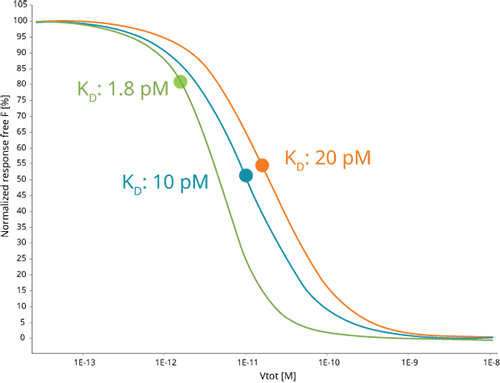
Measuring free fractions of interactants in equilibrated solutions with Gyrolab flow-through immunoassays provides unique advantages based on the short binding times for the affinity column. Short contact times of only a few seconds avoid the equilibrium shifts that are inherent in assays requiring long incubation times.

Gyrolab Affinity Software module facilitates the design and evaluation of in-solution affinity determination experiments. The software guides you in defining the interacting pairs and setting up the affinity sample series. At equilibrium, the response from the unbound interactant in each affinity sample is measured with an automated Gyrolab Affinity Analysis run, requiring sample volumes as small as 4 µL.

Affinity analysis results are available for review immediately after the assay is completed.

Affinity TNF antagonist KD webb

Validation and data confidence

Gyrolab is used in bioanalytical preclinical and clinical environments where data integrity, traceability, and reproducibility matter. Automated workflows reduce operator-dependent variation, while software support provides audit trails, controlled user access, and structured data handling to support compliance with GLP/GMP expectations.

Assays can be transferred between systems and sites with reproducible results, supporting long-term studies and regulatory submissions without added complexity.


Further reading

Scientist woman

Ready to improve your immunoassay workflow?

Discuss your affinity studies with a Gyrolab specialist and explore how automation could support your timelines and data needs.