%20(1).png)
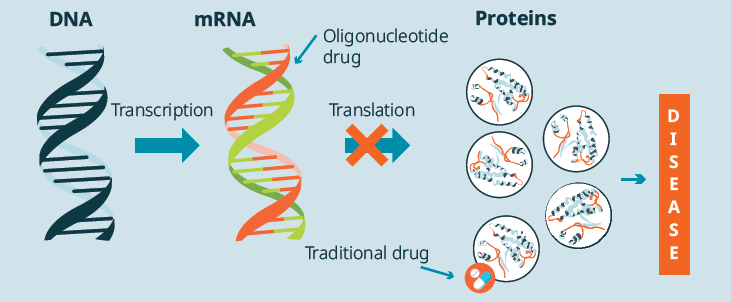
Cell and gene therapies represent a rapidly expanding area in drug development and with it a growing need for robust analysis tools to quantify oligonucleotide-based components in a variety of biological samples. We describe the development of several automated hybridization assays to analyze levels and distribution of ASO drug in the body.
Hybridization assays
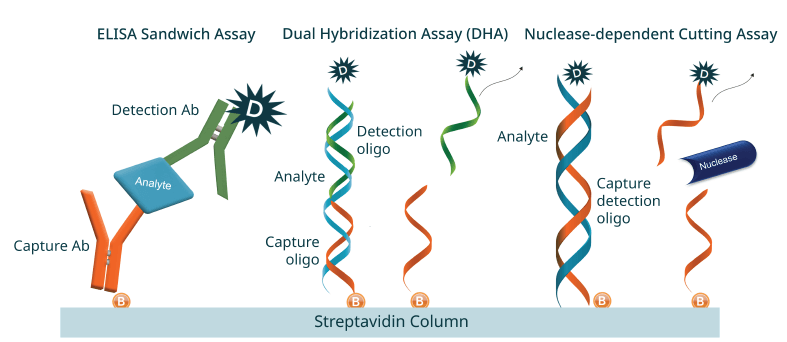
Standard immunoassays, like ELISA, utilize antibodies for capture and detection. Hybridization assays, on the other hand, use labeled complementary oligonucleotide sequences.
- Dual hybridization assays (DHA) - employ one capture and one detection oligo. If not held in place by the analyte, the detection oligo is washed away, and no signal is detected.
- Nuclease-dependent cutting assay (NCA), utilizes a full-length probe. Unpaired probes are cleaved by a nuclease and the detection molecule is washed away. The use of a nuclease improves selectivity for the parent oligonucleotide.
The Gyrolab technology
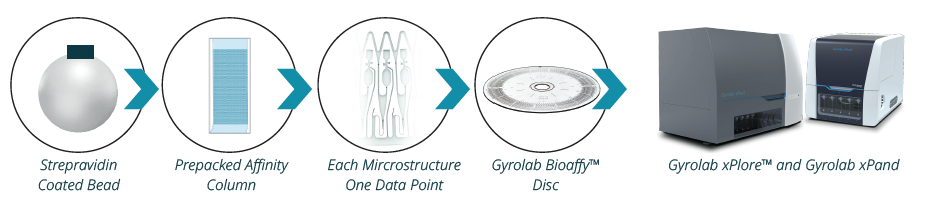
Microfluidic immunoassay technology utilizes automated delivery of samples and reagents by centrifugal force and capillary action. Analytes are captured by biotinylated reagents on streptavidin beads in flow-through 15 nL-columns on discs and detected by Alexa Fluor™ 647 labeled detection reagents.
Results
Gyrolab DHAs developed for different size ASOs
Pre-clinical and clinical pharmacokinetic (PK) measurements of oligonucleotide drugs can be challenging, as hybridization efficiency strongly depends on the sequence. Certain sequence features promote the formation of secondary structures or self-dimerization, that can interfere with probe binding.
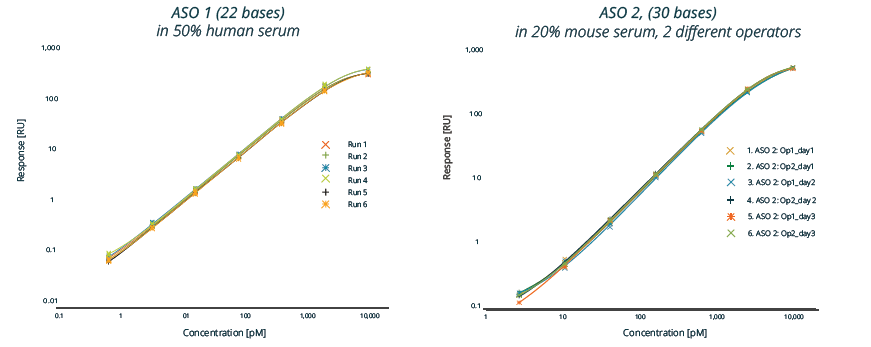
We developed DHA for three ASO drug analogs of different size (22-30 bases) and sequence composition on the Gyrolab® platform and all three ASOs could be reliably measured in serum, also when analyzed by different operators.
DHAs for ASO quantification in tissue homogenates
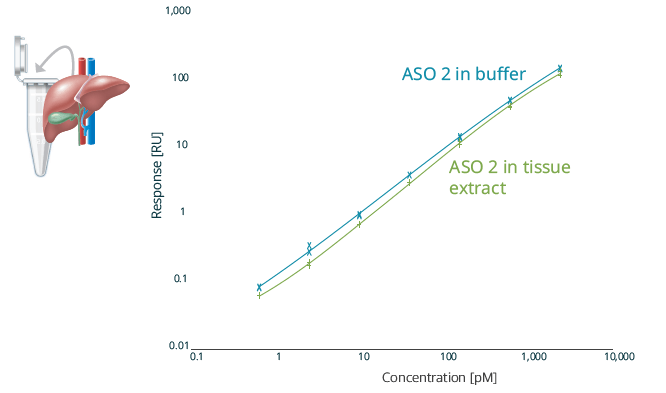
To assess the distribution of an ASO drug to different organs, PK studies include analysis of different types of biological samples, ranging from serum and spinal fluid to tissue homogenates. The Gyrolab method is generally tolerant to biological matrices and to assess the DHA performance in tissue we measured the levels of ASO in mouse liver homogenates. All three ASOs could be readily quantified in the liver extracts after dilution (dilution factor 8).
NCA on the Gyrolab platform - novel ultra-slow spin method
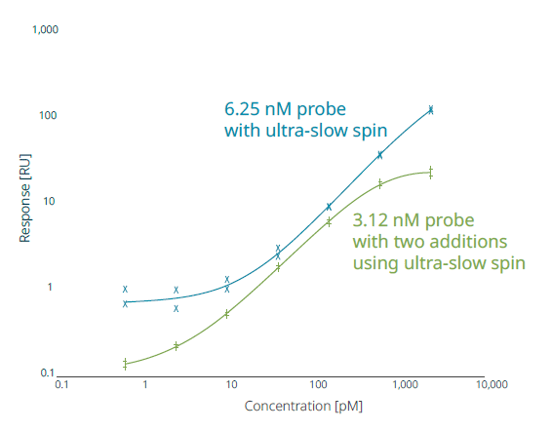
Nuclease-dependent cutting assays (NCA) were applied as an alternative method for ASO detection. By developing a novel microfluidic method to increase the time of on-column nuclease digestion we successfully quantified the ASOs by NCA. The sensitivity could be further increased by lowering the probe concentration.
Conclusions
- DHAs were successfully developed for the Gyrolab platform to quantify three ASO drug analogs of different size and sequence in serum and tissue extracts.
- NCAs to detect the ASOs were developed using a novel ultra-slow spin method to increase the contact time with the column.
- These results suggest that the platform has potential for PK quantification with high sensitivity and throughput of a broad range of ASOs in preclinical and clinical samples.
Want to know more?