
Gene therapy programs live and die by their analytics. Whether you are optimizing an upstream process, releasing a clinical batch, or characterizing a new construct, you need numbers you can trust — and you usually need them faster than a manual workflow can deliver. In a recent webinar, Daniel Forsström, R&D Application and Custom Service Manager at Gyros Protein Technologies, walked through how automated immunoassays on the Gyrolab® platform support viral vector titer and impurity analysis across the development journey. This post pulls together the practical takeaways for scientists working in gene therapy.
The analytical demands of gene therapy
An immunoassay platform that has to serve discovery, process development, and quality control faces a tough brief. Daniel framed it around five needs:
- Throughput to move a bioprocessing workflow forward without a sample backlog.
- Sensitivity you can tune to each assay's data requirements.
- A broad dynamic range, so you avoid repeat analyses that delay decisions and lot approvals.
- Reproducibility, with fewer manual steps and shorter turnaround.
- Flexibility, so a single vendor can support your assays from early development onward.
When one of these is missing, the cost shows up downstream: reruns, dilution work, and slower project decisions.
How Gyrolab addresses them
Gyrolab is a miniaturized, automated ELISA. Instead of a microtiter plate, the assay runs inside a proprietary disc with microfluidic structures — each containing a nanoliter-scale affinity column where the immunoassay takes place. The system defines those tiny volumes precisely, so assay precision does not depend on the operator's pipetting.
The practical effect for you is straightforward. You get high-quality immunoassay data in about an hour, using less sample and fewer manual operations. By removing hands-on steps, the platform delivers consistent, reproducible results and reduces sample and reagent consumption by up to a hundredfold. It automates up to 960 immunoassay datapoints per day, and because runs are unattended, you can start one in the morning and another in the evening and collect the data when you arrive the next day.
Flexibility runs through the design. The flow-through affinity format is open, so you are not locked to specific reagents — use reagents from Gyros Protein Technologies, your own, those from your existing ELISA kits, or a combination. If you would rather not build an assay from scratch, ready-to-use kits cover common gene therapy needs, and a custom assay service is available when your requirements are more specific.
Three case studies from the field
1. Higher-throughput AAV capsid titer — Pharmaron
Pharmaron, a CDMO with an extensive analytical platform for gene therapy, evaluated Gyrolab to raise throughput in upstream and downstream bioprocess development beyond what their manual capsid analysis allowed. Using the five-disc Gyrolab system, they measured three AAV serotypes — two with the Gyrolab AAVX kit and AAV9 with the dedicated AAV9 kit.
Compared with their manual ELISA, Gyrolab gave a lower limit of quantification and a broader dynamic range, with acceptable CVs. They also showed that calibration controls could replace multiple standard curves, improving throughput further, and that results stayed consistent across three separate runs and against commercial reference material. The conclusion: accurate, quantitative AAV capsid results at higher throughput, using smaller sample volumes — letting Pharmaron support multi-serotype titer testing with a faster time to results.
AAV capsid titer: a broader working range
Pharmaron case study—illustrative comparison, not to scale
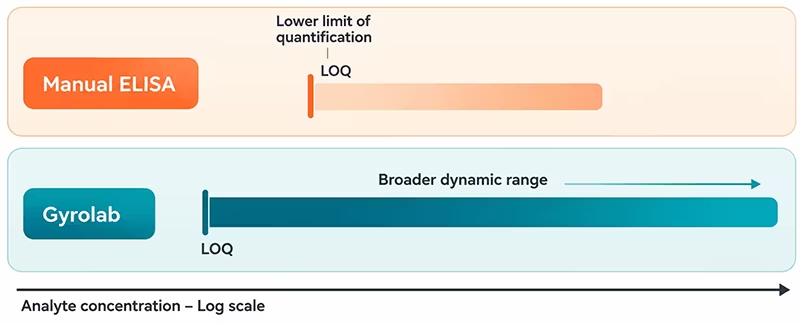
Figure 2. In the evaluation Gyrolab showed lower LOQ and broader dynamic range than manual ELISA woth acceptable CVs. Axis values are
not published and are not shown here (illustrative only).
2. Lentivirus p24 quality control — VIVEbiotech
VIVEbiotech, a GMP CDMO in San Sebastián specializing in lentiviral vectors, wanted faster, more reproducible immunoassays for characterizing their products. They started with p24 quantification, a key lentivirus marker.
Their existing manual p24 ELISA needed roughly 50 µL of sample, ran for more than six hours with about four hours of hands-on time, and showed a precision of under 20% CV. On Gyrolab, the same measurement used lower sample volumes, ran in under two and a half hours, and reached a CV below 10%, with recoveries around 99%. When they compared reference materials of known concentration, the Gyrolab values sat closer to the true value than the manual ELISA did.
A full seven-parameter validation — precision, accuracy, linearity, specificity, robustness, LOD, and LOQ — confirmed the picture: high precision with minimal matrix effects, and strong robustness to sample preparation and disk position. VIVEbiotech concluded that Gyrolab offered clear advantages for their quality control: about three times faster generation of release results, lower variability, fewer repeated assays, and better data integrity — including operator and date traceability that supports GMP compliance. One platform handled p24, HCP, and Benzonase testing across sample types and concentrations.
Lentivirus p24 quality control
Manual ELISA vs Gyrolab VIVEbiotech case study
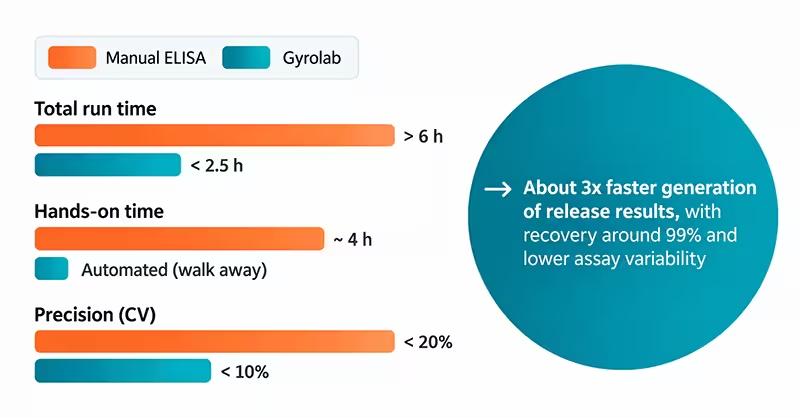 Figure 3. Source: VIVEbiotech quantification case study. Figures on reported time and hands-on bars share one scale.
3. Solving an HCP variability problem — Custom Assay Service
The third case shows what happens when a commercial kit does not meet your needs. A customer running an HCP ELISA for quality control was seeing high lot-to-lot variability. Already familiar with Gyrolab, they asked whether the assay could be improved and moved onto the automated platform at the same time.
The recommendation was collaborative: the customer sourced HCP antibodies tailored to their needs from an antibody supplier, and the Gyros custom assay team labeled the antibodies and developed an optimized Gyrolab protocol. Since 2021, this service has built custom kits around proprietary or commercial reagents, quality-controlled for consistent performance and supplied as complete kits or individual reagents. It is a route worth knowing about when off-the-shelf performance falls short.
From discovery to QC — and the questions scientists ask
Across all three cases, the same benefits recur: faster results, less hands-on time, lower variability, and data you can defend. Because the platform is 21 CFR Part 11 compliant, the same assays that speed up early development can also strengthen quality control in manufacturing.
A few practical points came up in the audience Q&A:
- Fitting into existing automation. The system takes standard microtiter plates as input and handles the transfer to the disk itself, so it sits comfortably downstream of liquid handling platforms you already use for high sample numbers.
- Running several assays together. The platform does not multiplex analytes within a single disk structure, but its small sample volumes let you run several quantifications from one sample — an approach Gyros calls "gyroplexing." On the five-disk system you can load a titer assay, an HCP assay, and a Benzonase assay, walk away, and return to data from all three.
- AAV serotype coverage. The AAVX kit binds generically across serotypes, with a dedicated AAV9 kit; together they cover the full serotype range.
- Custom assay timelines. These vary with scope, but development is quick because each Gyrolab run takes about an hour rather than half a day — so you reach conclusions and move to the next experiment sooner.
The takeaway
Gyrolab automates your viral vector titer and impurity assays at nanoliter scale, giving you consistent, high-quality data faster and with less manual work — from discovery through GMP quality control. If you are looking to raise throughput, cut hands-on time, or resolve a specific assay that is not performing, it is worth a closer look.
One platform, from discovery to QC
The same Gyrolab assays support each stage of gene thereapy development
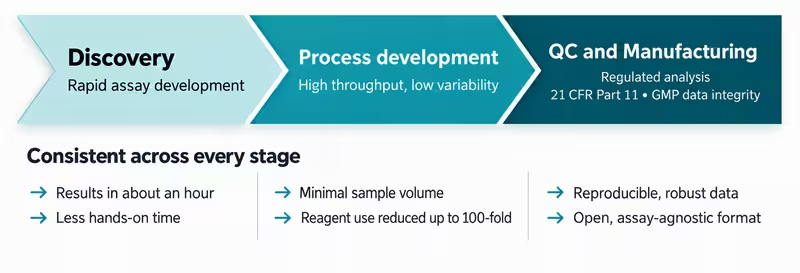
Figure 4. A single Gyrolab platform spanning the gene therapy development workflow. The same Gyrolab assays can be applied across three sequential stages of gene therapy development. In Discovery, the platform enables rapid assay development. During Process development, it delivers higher throughput with low variability. In QC and Manufacturing, it supports regulated analysis compliant with 21 CFR Part 11 and GMP data integrity requirements.
Interested in what this could mean for your workflow? Reach out to the Gyros Protein Technologies team to talk through your assays — or explore the on-demand webinar for the full case study data.
_________________________________________________________________________________________________________________
This blog is a summary from the Cell and Gene Therapy Insight webinar entitled "Improving viral vector titer and impurity analysis with automated ELISA systems"