
.webp)
When a single AAV batch has to answer questions about titer, process impurities, and contaminants — all under tight timelines and a GMP framework — the analytics you choose matter as much as the science behind them.
In a recent panel, four scientists came together to talk through exactly that: John Chappell, Executive Partnership Manager at Gyros Protein Technologies; James Norton, Director of Analytical Development at MeiraGTx; Iñaki Osorio Querejeta, QC Biochemistry Lead at Viralgen; and Barbara Rodriguez, Analytical Methods Validation Scientist at VIVEbiotech.
What follows is a summary of what they shared — the practical realities of running immunoassays in gene therapy QC, and where automated, nanoliter-scale analysis fits in.
Why impurity and contaminant analysis carries so much weight
In gene therapy manufacturing, purity is not a finishing touch. Residual host cell proteins, host cell DNA, nuclease, and other process-related contaminants can drive immunogenicity, contribute to toxicity, and affect product stability. Keeping them in check is a core part of showing that a drug product is safe.
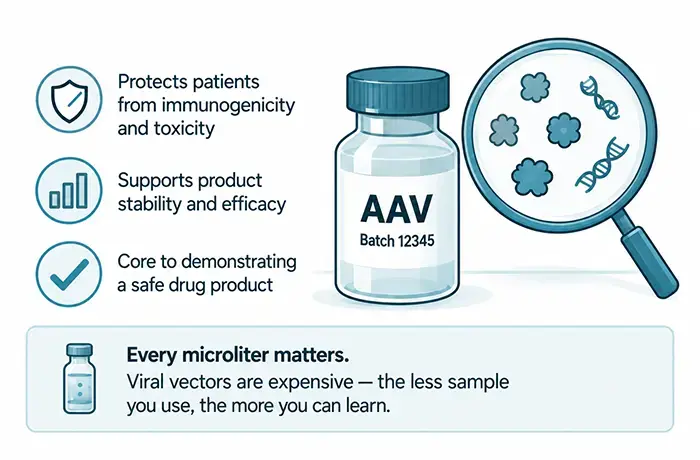
The challenge is that you have to measure all of this, sometime using very little material. Viral vector based therapies are expensive to produce, and every microliter you spend on one assay is a microliter you cannot spend on another. Traditionally, host cell protein, host cell DNA, and residual nuclease are assessed with methods such as ELISA, LC-MS, and qPCR. Wherever an ELISA sits in that workflow, an automated nanoliter-scale immunoassay can often take its place — and give you the sample back.
How Gyrolab approaches the problem
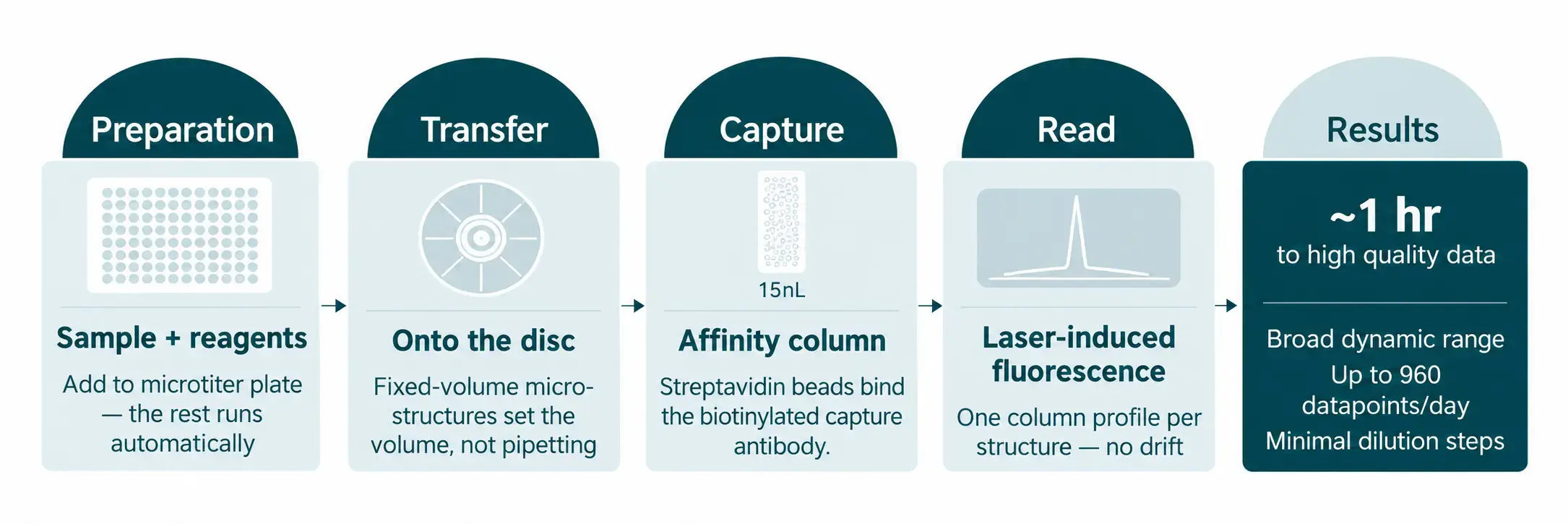
Gyrolab runs the immunoassay inside a disc with volume defined microstructures rather than a plate. Each microstructure holds affinity capture columns packed with streptavidin; the biotinylated capture antibody binds there, the HCPs bind next, and an Alexa Fluor™–labeled detection antibody completes the sandwich. After each addition, the disc spins, and centrifugal force drives reagents through the columns. A laser then reads the fluorescence, which scales with the amount of HCP present. The result is a automated workflow where the instrument does the running and reading for you.
A few technology characteristics stands out, and they map closely to what gene therapy work actually demands:
- Nanoliter scale saves sample and reagent. For low-volume, high-value viral vector samples, this is often the deciding factor.
- Laser-induced fluorescence gives a broad dynamic range. When you dilute impurity samples into range, it is easier to hit the standard curve and get a usable result the first time.
- Each microstructure produces its own column profile. Everything is processed at once, so you avoid assay drift and plate-level effects — and you get a visual read of the binding within the column.
- It is an open platform. You are not locked into the vendor's applications or reagents. You can run ready-to-use kits, adapt your own ELISA reagents, or have a custom assay developed — including cell-line-specific HCP assays, AAV ligand assays, and gene expression (potency) assays.
The platform has been automating ligand-binding assays for 20 years, so this is established ground rather than something new to validate confidence in.
What the QC scientists look for in an assay
Here the conversation got concrete. Asked what drives their choice of a QC assay, the panel kept returning to the same short list.
Barbara framed it around critical quality attributes — potency, identity, impurities, and safety — and what it takes to serve them in practice: delivering results on time, using a low volume of sample, good reproducibility, and cost-effectiveness. An assay also needs to be something you can validate, automate, and miniaturize.
James added the point that anyone who has run routine testing will recognize: robustness is key. A QC method has to work over and over again — across batches, across days, across operators. Understanding where that robustness comes from is what separates a method that survives in QC from one that does not.
Inyaki agreed and tied it back to the environment they all work in: under GMP, an assay has to be validated, robust, precise, and accurate. That is not a preference; it is a requirement.
When the discussion turned to whether a platform could be unsuitable for QC, James offered a useful reframe. Almost anything can be done in GMP as long as it is controlled — the real question is how hard that control is to achieve. Data integrity is often the biggest hurdle. So the goal is not to take on the hardest challenge; it is to choose systems that are simple to run and simple to keep compliant.
Off-the-shelf kit or custom assay?
One question many teams wrestle with: do you reach for a ready-made kit or develop your own?
James's answer was that it usually does not have to be either/or, and each has clear strengths.
An off-the-shelf kit keeps everything in one place, which makes material supply and control much easier and helps you plan routine testing. There is another, less obvious benefit: when you bring a widely used kit to your QA validation group, they tend to be more confident in it, and the validation process runs more smoothly. System suitability is often predetermined and controls are readily available, so there is less pre-work.
A custom assay earns its place when you need more. Development lets you optimize sample preparation and concentrations for your specific sample, and it builds deep internal understanding of how the method works — understanding that pays off later during out-of-specification investigations and troubleshooting, because your QC group was involved from the start. Custom development also tends to include more robustness testing before validation, so you arrive with a clearer picture of matrix interference and the reasoning behind your reagent choices.
His practical recommendation: if a kit exists, look at it first and try it. But do not treat custom development as a lesser path.
Moving a method from development into QC
James walked through how method transfer works at his company, where analytical development sits within R&D rather than under quality. The pattern is worth borrowing.
Technique and platform selection happen in R&D. As soon as there is feasibility or proof-of-concept data, the team goes back to the QC and QA groups to show them what they have — the systems, any new equipment, the materials — and gets them on board early enough to surface issues while they are still cheap to fix. With that input in hand, they move to full method development, then a focused optimization round following ICH guidance on repeatability, accuracy, and precision. The result is an R&D qualification report that QC can use to establish and validate the method, already knowing the targets they are aiming for.
The recurring lesson across the panel: transfer never goes as smoothly as the plan suggests. Good planning, good communication, and teamwork carry most of the load — matching equipment, lot and serial numbers, SOPs, and testing documents across sites. But the piece that is easiest to underestimate is tribal knowledge: the small things a scientist does at the bench to make an assay work that never get written down. That is why face-to-face time in the lab, doing the training or the first runs side by side, matters so much. Barbara added that QA needs to be part of this from the start too, and that in her experience the paperwork often takes longer than running the assays themselves.
On this point, several panelists noted that a fully automated assay is easier to transfer, precisely because there is less manual technique to hand over. Different instruments may give slightly different absolute response values, but standard curves stay essentially identical. Inyaki confirmed a two-lab tech transfer at his organization that came through with no meaningful difference.
Does it hold up for regulated work?
Yes. Gyrolab data has been submitted to the FDA, and the platform is in use across bioanalytical, GMP, and GCP settings. As John emphasized, what matters for any immunoassay is the same underlying discipline: the method is fully validated, the system is fully qualified, and computer systems validation is in place.
Two of the panelists spoke to this directly from their own labs. Mirror GTX has Gyrolab validated and in use for late-phase work and product release, with plans to use it in their BLA commercial application. Viv Biotech reported the same — validated and used for release.
What the panel wants from the next five years
Looking ahead, the scientists were aligned on direction: more cost-effective analytics, higher throughput, and higher levels of automation, all within a GMP-compatible framework, so they can generate more data from less sample. Barbara also pointed to a clear trend toward deeper characterization of viral vectors and the production process — going beyond titer and impurities.
James named a specific gap worth watching: better standards and controls for AAV. He would like to see improved, serotype-specific antibodies, and ultimately a universal standard — for titer, or for full/empty ratios — that allows comparison not just across platforms but between companies.
Where this leaves you
If your work involves quantifying titer, host cell proteins, host cell DNA, residual nuclease, or other process impurities in gene therapy — and you are doing it with limited sample under regulatory expectations — the through-line from this panel is straightforward. The methods that succeed in QC are the ones that are robust, validatable, simple to control, and economical with sample. Automation helps by removing manual variability, and it makes methods easier to transfer between labs.
For the panelists who use Gyrolab, the reasons they gave were consistent: low sample volume, minimal matrix interference, fast method development, a simple user interface, and reduced hands-on time — which in turn means lower error and more robust results. John, who used the platform as a customer for over a decade before joining the company, put speed first: the ability to run three or four runs a day, rather than one, changed how quickly he could get a method up and running.
No platform is without limits. As John noted candidly, you still handle your own sample dilutions, and for applications that need femtogram-level sensitivity the platform may not be the right fit — though it covers most biomarker analysis comfortably.
This blog summarizes a Cell and Gene Therapy Insights panel discussion. For assay-specific questions — including matrix effects, interference from lipemic or hemolytic samples, and custom assay development — we recommend evaluating performance with your own method and samples.