
Titer testing sits on the critical path of almost every AAV program. You need capsid numbers to make process decisions, and you need them to hold up from discovery through QC. But the manual, plate-based ELISAs many labs still rely on are slow, hands-on, and narrow in range — which means dilutions, reruns, and days lost while a batch waits.
In a recent webinar, three of our field scientists walked through how labs are replacing those manual assays with the automated Gyrolab® platform. Two customer case studies did most of the talking. Here's what they showed, and what analytical scientists and lab managers wanted to know.
Why the platform matters, in plain terms
Gyrolab is an automated, miniaturized immunoassay technology. The immunoassay runs inside a nanoliter-scale affinity column on a compact disc — the Gyrolab Bioaffy™ disc — where precise microfluidic structures define each assay volume instead of a pipette tip. That single design choice explains most of the benefits you'll see below:
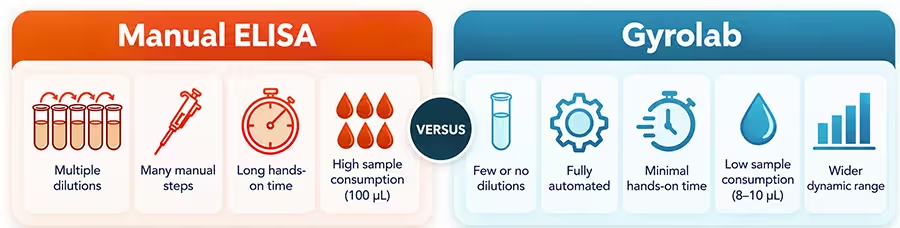
- Results in about an hour, rather than the four to six hours a traditional ELISA workflow typically takes.
- Minimal sample and reagent use — as little as 8 µL to run duplicates with the AAVX Titer kit, which protects the material you'd rather send toward the patient.
- Minimal matrix effects, because the flow-through format keeps contact between sample and reagent short.
- A broader dynamic range, which is where the manual dilution work usually disappears.
Each microstructure produces one data point, shown as a peak in the result file. The peak shape tells you something about data quality, so you can use it to troubleshoot or to fine-tune assay conditions — a level of visibility you don't get from an OD readout in a well.
You also keep flexibility on reagents. You can use ours, your existing ELISA supplier's, or a combination. If you'd rather not develop from scratch, ready-to-use kits cover the common cases: the AAVX Titer kit binds AAV serotypes 1–8 plus recombinant human AAV10 (AAV9 has its own dedicated kit), and there are kits for p24, for HEK293 HCP and for endonuclease impurity testing.
Case study 1: replacing a manual viral titer ELISA
A biopharma customer expected their AAV sample load to grow and wanted faster turnaround without giving up comparability to their existing plate-based ELISA. They built an evaluation plan around four questions: dynamic range, robustness, dilutional linearity, and comparability.
The robustness test ran four assays across four days with two operators. The runs overlapped cleanly, and the data sat well within the ELISA's own range — with the added benefit that the wider dynamic range of Gyrolab removed much of the manual dilution work from their AAVX titer workflow. Dilutional linearity held up across eight samples drawn from different purification stages, with CVs below 10%.
Dynamic range comparison
.avif)
Comparability is where the nuance came in. Testing the same eight samples on both platforms, six of eight fell inside the 80–120% window. The two that didn't were older samples carrying aggregates; after centrifugation, they came into line. It's a useful reminder that sample condition, not platform, drove the difference — and that the wider dynamic range let the team use much smaller dilutions to reach good agreement, even though the two methods use different antibodies.
Their conclusion: Gyrolab supported the performance of the plate-based assay and could be adopted for AAV titer testing in their lab.
Case study 2: transferring an AAV2 ELISA in a day and a half
The second study transferred a commercial AAV2 ELISA onto Gyrolab, with a clear brief — keep the accuracy and precision, widen the analytical range, and cut analyst time.
The team worked step by step: choose the right Bioaffy disc for the titer range, optimize capture and detect reagent concentrations, set the analytical range, confirm accuracy and precision, then check dilutional linearity. The Bioaffy 1000 disc gave the best sensitivity and range for this assay, and a detect concentration of 5 µg/mL gave the best signal-to-background.
The range difference was the headline. The Gyrolab assay covered roughly three logs of capsid concentration against about two logs for the traditional ELISA — enough to run more samples neat and reach the linear range with fewer dilutions. Spike-recovery across high, medium, and low QCs showed good accuracy and precision, and dilutional linearity across 8-, 16-, and 32-fold dilutions gave a group CV of 4.5%.
What it added up to for the lab:
-
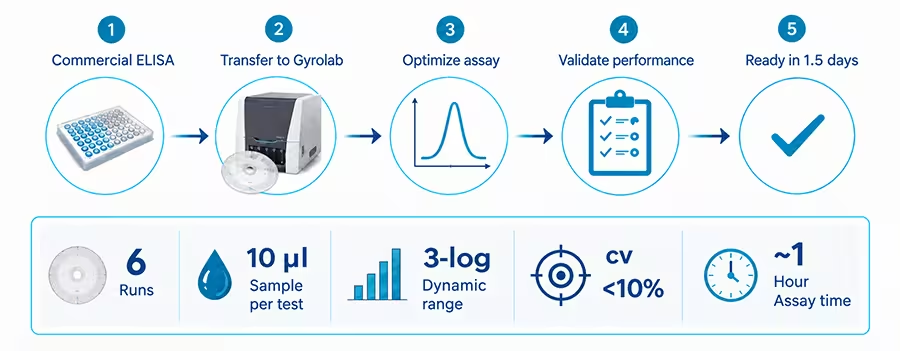
- Method development done in a day and a half, over six runs.
- 10 µL of sample per test versus 100 µL on the ELISA — a real saving in scarce material and reagents.
- Assay performance as good or better, with CVs under 10%.
- Analytical range improved from two logs to three.
- Assay completion in about an hour, against four to six for the traditional workflow — at the same number of data points.
From manual ELISA to validated Gyrolab assay in 1.5 days
What analytical scientists and lab managers asked
The Q&A is worth listening to in full, but a few answers stood out for people running the assays and the labs:
Can I run crude, upstream material? Yes. Both AAV kits are designed for upstream and downstream samples. Depending on cell debris, you may need to centrifuge first, but the flow-through format limits matrix interference.
Does it fit our automation? The disc takes samples and reagents from a standard microtiter plate, so any liquid handler that works with microtiter plates fits alongside it — customers run full workflows with systems such as Hamilton and Echo.
What throughput can we plan for? As a rule of thumb, the single-disc Gyrolab xPlore handles about six runs (6 × 96) a day; the five-disc Gyrolab xPand handles roughly 10 discs a day, depending on how you schedule runs.
How do we handle standards in a regulated setting? A common approach is a full standard curve on disk one, then a subset of calibrators on the following disks. The system checks the calibrators against that reference curve and does the math for you. Running a full standard on every disk is also fully supported.
How long to develop a new assay? The case study above took a day and a half. As a general guide, giving yourself about a week usually gets you to a spec that's ready to move into validation.
Where this fits in your program
If your titer testing is becoming a bottleneck — too many dilutions, too much hands-on time, or a range that forces reruns — the case studies suggest a practical path from a manual ELISA to an automated assay, without giving up comparability or regulatory readiness.