
Host cell proteins (HCPs) are one of the quieter risks in gene therapy manufacturing. These process-related impurities carry over from your production cell line, and because they can be immunogenic, you need to show they are cleared to acceptable levels in your drug substance and drug product. That calls for a sensitive assay you can trust: one that quantifies HCPs and tracks their clearance across your whole process.
Many teams start with a commercial HCP kit because it’s the fastest way to get going. In a recent webinar, the analytical development team at Ultragenyx explained why they moved away from commercial kits entirely and built their own custom HCP assays on two platforms instead. Their experience offers a practical look at what it takes, what you gain, and where each platform fits.
Why move off a commercial kit at all?
Commercial HCP kits are convenient. You can order them on demand, and their generic antigens and antibodies are designed to detect a broad range of proteins. For many programs, that is enough.
Two things pushed Ultragenyx to look further. The first was cost: a single commercial plate — one assay — ran to roughly $800. The second, and more important, was supply risk. Relying on one vendor means a single shortage can leave you without a working HCP assay for weeks. In a regulated environment, that is not a small exposure.
So the team set a clear goal: develop custom, in-house HCP assays that would support every gene therapy program, give them freedom to run on whichever platform suited the task, lower their per-sample cost, and — by owning the reagents outright — take the supply risk off the table.
The foundation: getting the reagents right
A sandwich immunoassay is only as good as its two critical reagents — the antigen, which serves as your standard, and the antibody, which has to recognize the majority of the HCPs actually present in your process. Get either wrong and the assay quietly misses what you need it to see.
Ultragenyx produced the antigen in-house. Their upstream group grew a suspension cell culture using a null cell line — the production process without the product — so the material would represent real process HCPs and nothing else. That harvest was clarified by depth filtration, then concentrated and buffer-exchanged by tangential flow filtration.
Before committing to it, they checked that the antigen was representative. Running a typical harvest pool and the HCP antigen side by side on 2D gels — which separate proteins by molecular weight (here, from about 220 kDa down to 14 kDa) and by isoelectric point — let them compare protein-by-protein. The product-associated proteins showed up in the harvest pool but not in the null-cell antigen, exactly as expected, while the two shared a large set of common HCPs. That was the confirmation they needed.
The antigen then went to an external CRO for antibody production. Over roughly nine months, 20 rabbits were immunized with the custom antigen; the serum was then purified first over a protein A column and then over an antigen-affinity column, giving a polyclonal antibody tuned to their own process. Coverage analysis put the antibody at 75–82% of the custom antigen — a solid, industry-typical result, and enough for the team to move forward with confidence.
One practical note worth borrowing: they produced a single bulk batch of antibody, sized to last the lifetime of the product. New antibody lots rarely reproduce exactly, and each change brings comparison work and justification. One well-characterized batch avoids all of that.
The ELISA: reliable, but hands-on
The first assay was a custom HCP ELISA in a standard format — capture antibody coated onto the plate, then sample and standard, a biotinylated detection antibody, an HRP–streptavidin conjugate, TMB substrate, and a read at 450 nm. The same custom antibody did double duty: unlabeled for capture, biotinylated for detection.
Optimization came down to a few decisions. Higher reagent concentrations gave strong signal and low background, so the team chose a condition that balanced both rather than chasing the highest signal at the cost of a noisy blank. Standard curve range mattered more than expected: wider curves looked appealing but recovered poorly at the low end, where it counts. A narrower curve — 200 down to 1.56 ng/mL — recovered accurately almost all the way to the bottom, using a 70–130% recovery window.
Repeated LLOQ testing (six replicates each at candidate concentrations, requiring four of six within range) settled the lower limit of quantitation at 5 ng/mL. Drug substance came back clean — no detectable HCP — while spiked antigen recovered accurately across the curve, with dilution linearity above an R² of 0.99. The assay was qualified across several programs and transferred to QC for release testing.
It worked. But ELISAs are hands-on and comparatively low throughput: every addition means an incubation, a wash, and the next step. For a group supporting process development, with a steady stream of in-process samples, that becomes the bottleneck.
The Gyrolab platform: same reagents, more room to breathe
To handle volume with less manual work, the team moved the same custom reagents onto their Gyrolab® system.
Gyrolab runs the immunoassay inside a disc rather than a plate. Each disc holds affinity capture columns packed with streptavidin; the biotinylated capture antibody binds there, the HCPs bind next, and an Alexa Fluor–labeled detection antibody completes the sandwich. After each addition, the disc spins, and centrifugal force drives reagents through the columns. A laser then reads the fluorescence, which scales with the amount of HCP present. The result is a workflow where the instrument does the running and reading for you.
Development was quick — about a month, helped by early input from the Gyrolab team on antibody concentrations and parameters to test. Holding the capture antibody constant and titrating detection let them settle on a condition that gave clean, reproducible curves. Because analytical development sees such variable HCP levels, they deliberately built a broad standard curve: 1000 down to 0.46 ng/mL. The LLOQ landed at 1 ng/mL, five-fold lower than the ELISA, and samples showed good dilution linearity — group CVs comfortably under the 20% criterion, and results consistent across analysts, runs, and days.
Reassuringly, the two platforms agreed. Run on the same samples, the custom ELISA and the custom Gyrolab assay gave comparable results and showed the same HCP clearance from harvest to drug substance — the sign that the underlying reagents, not the format, were doing the work.
What actually changed, in numbers
The clearest way to see the difference is side by side.
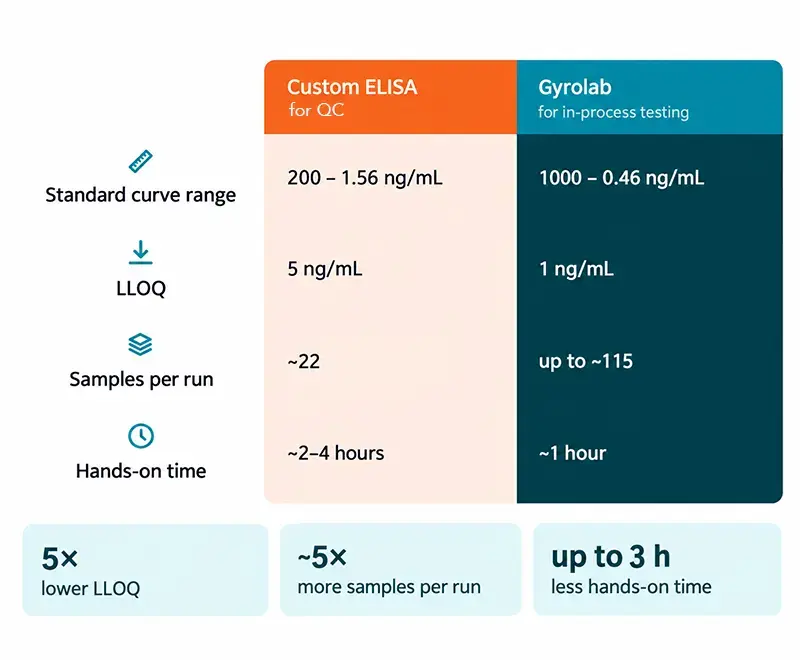
Fig 1. Custom HCP assay — platform comparison. The same custom antigen and antibody run on both formats — so you can match the platform to the task instead of rebuilding the assay.
That hour of hands-on time on Gyrolab is essentially just sample and standard prep — a step the team is now automating, which should reduce it further. The instrument runs the assay and analyzes the results once you start it.
Where they landed — and why it's the credible answer
Ultragenyx did not simply swap one platform for another. They retired the commercial kit and kept both custom assays, each where it earns its place: the ELISA transferred to QC for release testing, on a platform QC already knows well, and the Gyrolab assay serving as the platform method for the high volume of in-process testing in analytical development. Because Gyrolab supports 21 CFR Part 11 workflows, the team sees a path to QC adoption over time as well.
That fit-for-purpose split is the honest lesson here. The gain was not magic — it was five-fold lower quantitation, roughly five times the samples per run, and a meaningful drop in hands-on time, all built on reagents the team now owns and controls.
Takeaways for your own program
If you are weighing a custom HCP strategy, a few points from this work travel well:
- Plan around the reagent timeline, not the assay. Antibody production was the long pole — close to nine months — while assay development on each platform took a month or two. The reagents are the project.
- Invest in one well-sized antibody batch. Producing enough to last the product's lifetime sidesteps the comparison and justification work that new lots create.
- Match the standard curve to reality. A narrower, accurate curve beat a wider, shaky one on the ELISA; on Gyrolab, a genuinely broad range worked because the platform held its low-end recovery.
- Let throughput needs pick the platform. A validated ELISA is a fine fit for QC release; a disc-based, higher-throughput assay fits the sample load of process development.
Building HCP reagents in-house is a real commitment of time. But when it removes a supply risk, lowers cost per sample, and frees up meaningful lab time, the return is concrete and measurable — which is exactly the kind of result worth building on.
_______________________________________________________________________________________________________________
This blog summarizes a BPI Difgital week webinar. You can listen to the full webinar in the link below.